
Venice Week Two
Home, Erotics, Anarchy and Establishing Rapport

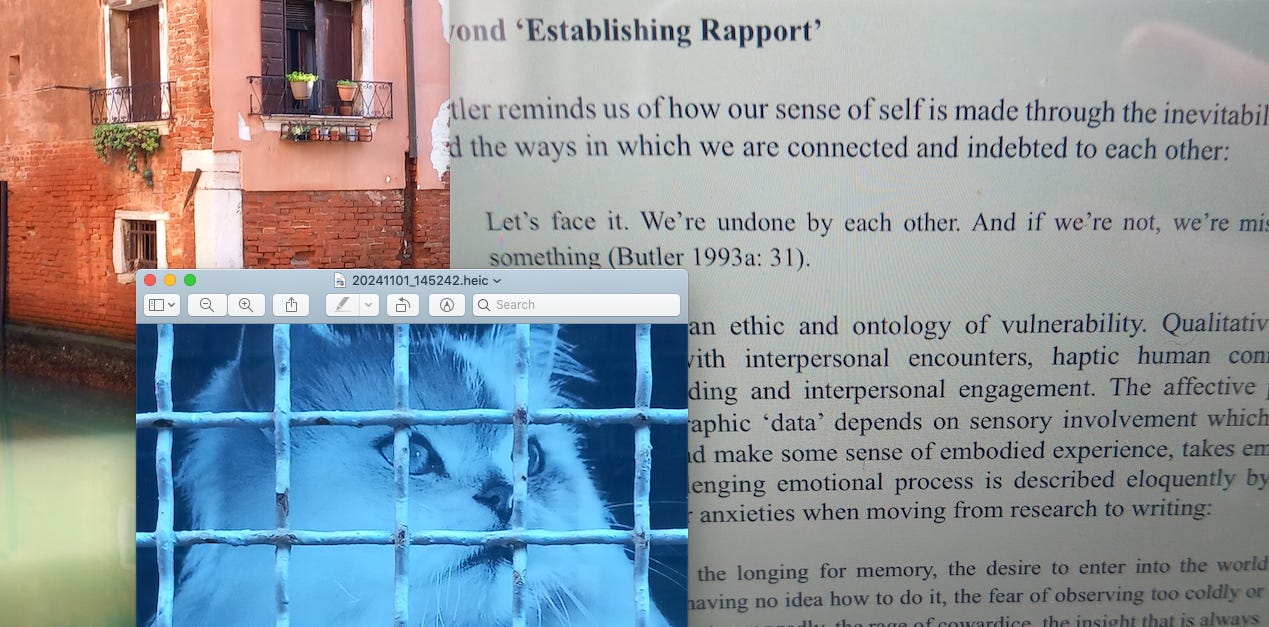
Canals, Calles, divine felines and a brilliant quote by Judith Butler
Week two has seen Holly and Arlo leave, and Steph and Finn arrive and leave. I had some nice time with Joel, who was out for a few days visiting the biennale. It has been my first stint of solo time. Around working about 3 days at the British Pavilion, ensconced in the strange audio-visual immersion of All Night Listening to the Rain, I have been walking, writing, feeling loads of feelings, reading, writing and finally, sleeping. I felt ill this week, but recovered by the end of the week. I have been enjoying the sensuality of my body. The temporality of not working full time hours, and having time off work, and communicating with friends and my lover. My new film on Withdrawal is also being exhibited as part of the Descansos exhibition in Vienna this week. I’ve managed to see quite a few exhibitions.
“Let’s face it. We’re undone by each other. And if we’re not, we’re missing something.” (Butler, 1993, p.31)
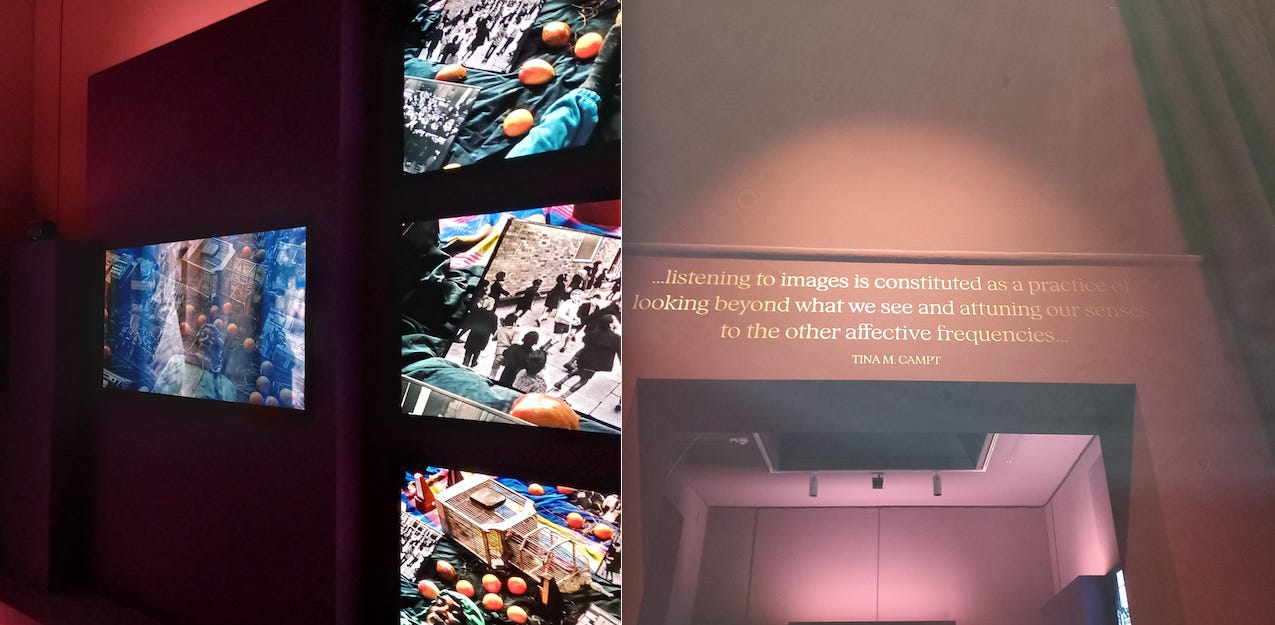
Sitting with John Akomfrah’s All Night Listening to the Rain
Squats & Co-ops and moving closer to mum
At many points this week, I have observed in myself a strong desire to move back home. Even calling Hebden Bridge home is telling. That word, a metaphor for familiarity and belonging, falls out of my mouth so easily. Hebden. Home. Moors. Home. Northern humour. Home. Saying it how it is. Home. Shared experiences of class. Home. The longest place I lived growing up - we moved around a lot for work. Home. This strong feeling is rooted in a drive for proximity and intimacy. Being able to get close to my family, and in particular, my mum easily and quickly. An instinct rooted in wanting to care for her as she ages, to stay close.
Alongside this, being close to Venice’s only squat, like one minute round the corner from Morion, has reminded me how much my politics and values align with taking over and redistributing property. Add to that, me feeling kind of distant from my house in Mach, and also feeling as though running a house as a single owner-occupant, doesn’t make it easier to work less hours for a wage, which is ultimately what I want to do.
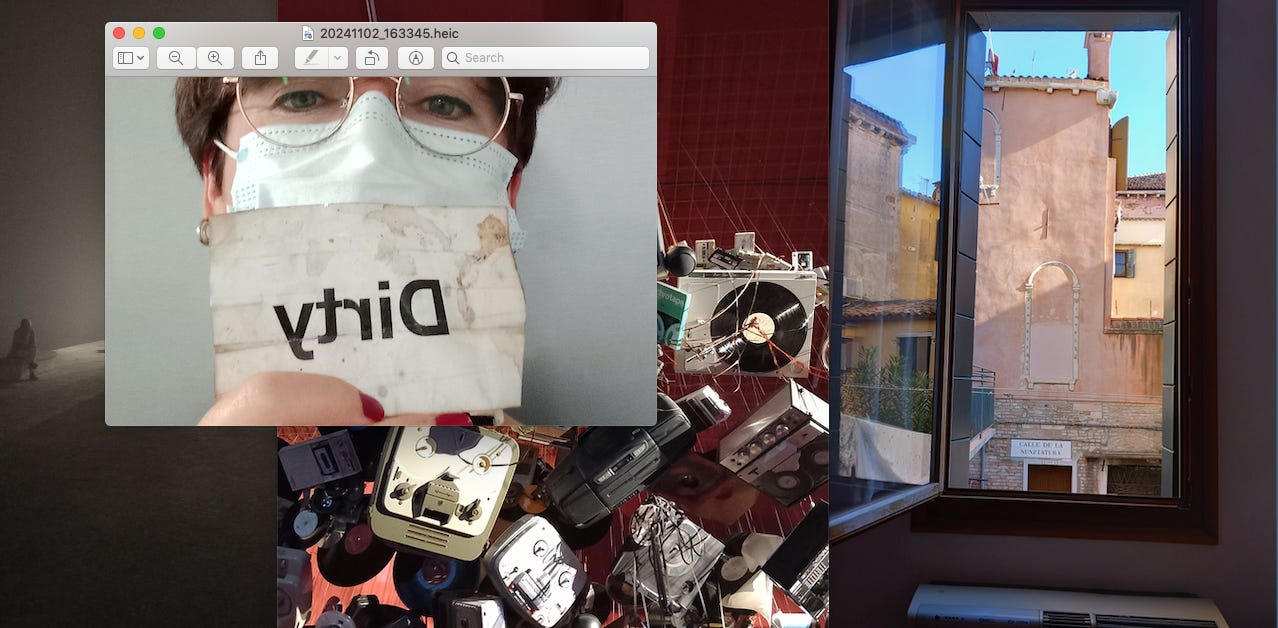
Lunch break signs, John Akomfrah’s audio installation & the view from my flat
I love the house in Mach, and all the things I’ve done to it so far, but I often feel very alienated by aspects of the wider community in Mach. Incorporate into the mix, the fact that I don’t yet speak Welsh, and I feel this risks a form of neo-colonialism that I’m knowingly upholding, I’m not entirely sure that I want to stay deep set down in Mach for the next phase of my time, the next chapter. Additionally, it’s really hard to secure the work I want to do in Machynlleth, and therefore in terms of job security, which expand a little if I learn Welsh, are limited.
The pull towards mum, Sam and the kids is visceral. Extremely potent. Strong and recurring. There are other reasons to head North that are close to my heart, and offer a strong pull. Though I’m not going to unpack nor detail them here. I am chewing on this recurring drive I feel while here in Venice. Waking through the Calle’s at night. Along the canals. Listening to music, staring out into the dark liquid surface of the waterways. Trying to find my anchor in socio-geographic-economic fabrics. It is not obvious nor easy. Especially when not really from anywhere specific, and transatlantic by conception. Holding it in my hand. Wondering what next. Thinking about what my job-work strategies are once the Cambridge contract ends. One thing is for sure, if I can get one, the next secure job will be a permanent, or at least a three year contract.
Ideas taken from Sex Ecologies - Swimming, Indigenous Sovereignty, Anarchy, and Love
Sex Ecologies (Hesler, 2021) explores pleasure, affect, and the powers of the erotic in the human and more-than-human worlds. Arguing for the positive and constructive role of sex in ecology and art practice, the texts and artistic research projects contained in this book attempt to reclaim sex, sexuality and gender from Western erotophobia and heteronormative narratives of nature and reproduction. I brought the book with me, as I’ve been dipping in and out of it since I bought it at the end of lockdown. It ties into themes I’m thinking about; disobedient bodies; gender binary blurring; trans experiences; queerness and colonialism; critiques of heteronormativity. It's a good read, and the interview that engaged me the most so far, is Swimming, Indigenous Sovereignty, Anarchy, and Love niilas helander in conversation with Katja Aglert and Stefanie Hessler.
Key topics and ideas that resonated with me in this transcribed conversation are the value of promiscuous gay sex, exploring how to make sex and access to sex more egalitarian (is this possible?!). Work by the poet Essex Hemphill who wrote about the AIDS crisis, Sarah Ahmed’s idea of queer vandalism, which I definitely need to look up in her book What’s the Use? On the Uses of Use (Ahmed, 2019), the dangers of instrumentalizing queerness, especially in relation to racism and classism. And there was this section on exploring the relationship between queerness and colonial histories and power structures.
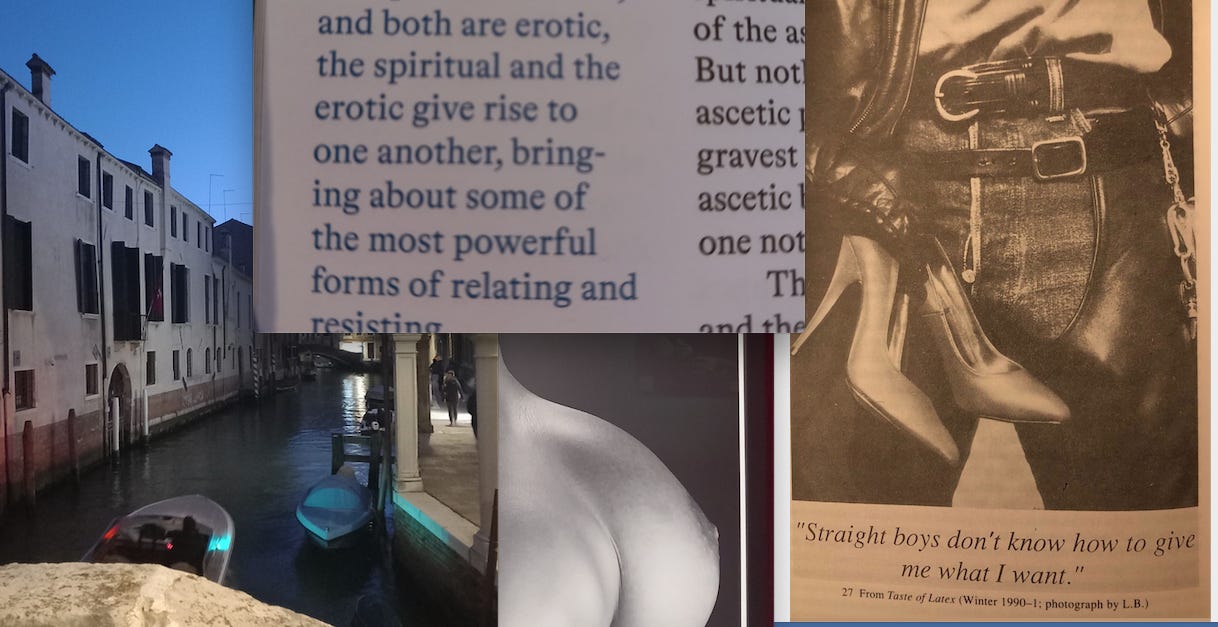
Walking, Lisa Lyon’s Tits, Audre Lorde’s Uses of the Erotic and a solid Instagram find
“I recently came across a very interesting researcher, Joseph M. Pierce, who wrote a Twitter thread,
“On why I’m teaching a course called ‘Decoloniality and Queer Studies’: The premise of gender and sexuality in the Americas, even at its most ‘performative’, is predicated on colonial power structures that are left unexamined by most queer theory. In other words, queerness is only possible within the normative framework of colonial / racialized/gendered power, and thus, only exists insofar as it crosses the boundaries pre-imposed by coloniality. So there can be no such thing as “queerness” within the epistemologies of Indigenous peoples, because “queerness” is only possible from the standpoint of non-Indigenous thinking and embodiment.” (Hesler, 2021, p.122)
I later looked up Joseph M Price who describes himself on his website as “Associate Professor in the Department of Hispanic Languages and Literature at Stony Brook University. His research focuses on the intersections of kinship, gender, sexuality, and race in Latin America, 19th century literature and culture, queer studies, Indigenous studies, and hemispheric approaches to citizenship and belonging.” His work looks really interesting and I’ll be looking him up in more detail.
What really stood out to me in his reasoning about why he’s developing and teaching the course Decoloniality and Queer Studies, is his claim that the very notion of queerness is rooted in colonial power structures. Queer as a concept and practice, according to some scholars has come about to push back against colonial thought, values and action in the world. Not everywhere in the world has experienced the violence and cultural hang over of colonial domination. And so indigenous cultures may not need nor identify with western notions of queerness, because they are not built on the same violent social structures and western colonial nations (though of course, many have been dominated and oppressed by colonisers). I found this line of analysis interesting, and am still musing on it.
However, at the same time, I think it’s extremely important not to fragment and divide the queer aim and labour; to challenge, critique and re-imagine the pervasiveness of cisgenderism, heteronormativity and violent oppression of gay, lesbian, bi, trans and queer peoples. And, based on Price’s claim that in the States, a lot of queer theory has not been scrutinised in terms of its relationship to colonial power structures seems an important claim to take seriously. But at once, I want to tend to diversity, and not undermine or fragment the importance of queer theory, critique and diversity.
Montenegro Pavillion - Nebula
The Montenegro Pavilion is the Pavilion that moved me the most last week. Nebula is a group exhibition curated by Alessandro Rabottini and Leonardo Bigazzi that features 8 new site-specific video installations commissioned to Giorgio Andreotta Calò (1979, Italy), Basel Abbas and Ruanne Abou-Rahme (1983, Cyprus/1983, USA), Saodat Ismailova (1981, Uzbekistan), Cinthia Marcelle and Tiago Mata Machado (1974, Brazil/1973, Brazil), Diego Marcon (1985, Italy), Basir Mahmood (1985, Pakistan/Netherlands), Ari Benjamin Meyers (1972, USA), and Christian Nyampeta, and produced by Fondazione In Between Art Film.
Nebula in Latin means Cloud or Fog. In the church and old hospital / retirement venue, Complesso dell-Ospedaletto, the space is transformed into a sensory architecture, a range of films and immersive installations are shown.
I was deeply moved by the work of Basel Abbas and Ruanne Abou-Rahme. The work was Called the Until we became fire and fire us (2023–) . I need to go back and rewatch it, but it has infused documents of displaced people, political histories of people forcibly removed from their land, and the deep longing, remembering and grieving that such evictions and displacements create.
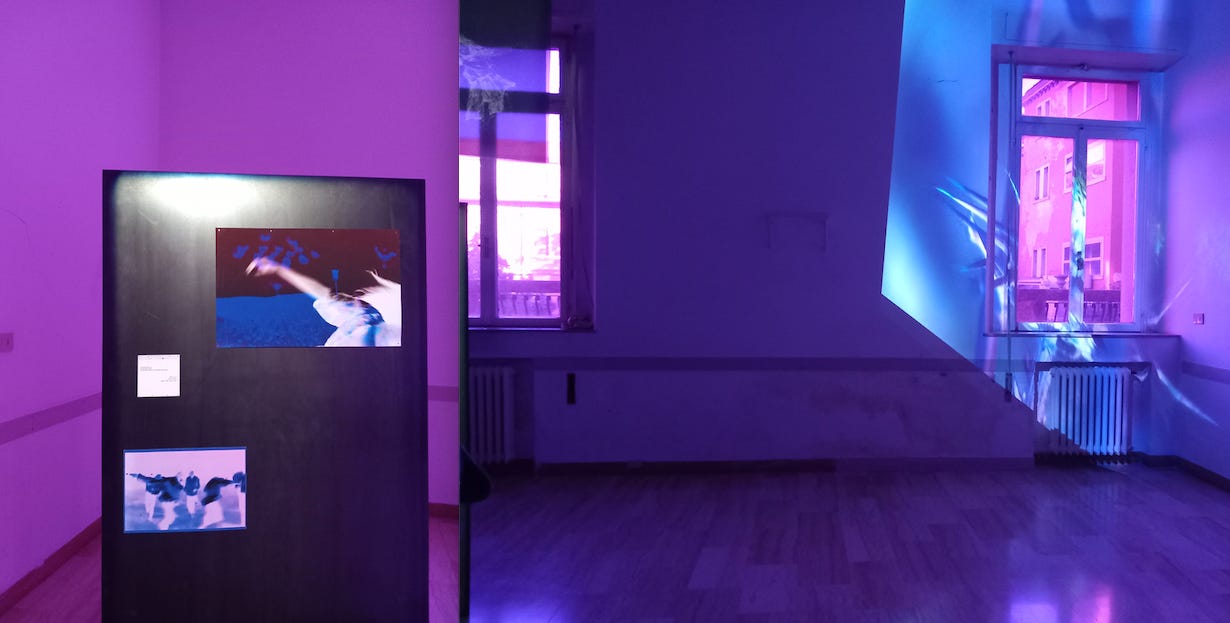
Basel Abbas and Ruanne Abou-Rahme, Until we became fire and fire us (2023–)
The sound and moving image created an ambiance of defiance, refusal and grief. I felt such sadness and despair wash over me as I watched the film. And though deeply painful, I was glad that such potent and concise forms of communication exist in the world. And that we have more than words to lean on when trying to convey the brutality of genocide and forced displacement playing out historically and right now.
Crying in St Michele Cemetery
Disembarking the water bus, the serenity of this island of the Venetian dead is beguiling. Soothing. You enter through a small archway, and pass through a well tended garden, with information booths and toilets flanking an elegant rose garden.
The cemetery itself is large and rambling. It has a simple and essential structure, with a Greek cross plan, a perimeter of solid red bricks, in turn circumscribed by Istrian stone - which is a lime stone commonly used in Venetian buildings.
As soon as you enter the cemetery, you are met with different squares within squares; essentially different plots of graves, organised according to time, ethnicity and in some cases social stature and wealth. Inside the cemetery is divided into three areas, depending on the religious denomination: Catholic, Orthodox and Evangelical. A part reserved for the Jewish religion is missing because there is a cemetery dedicated to Judaism on the Lido. Though I don’t yet know the reasons for a separate burial site.
There are free standing buildings, which I read to be kind of crypts. Within the cemetery layout there are also two cloisters. The small one just after the entrance portal is in Gothic style, with an irregular plan and a well in the centre. The large cloister was built by Giovanni Buora and has three sides enclosing the adjacent magnolia garden. The ambiance here is serene; cared for; reverent. I was already holding Elizabeth in my mind, as it was her birthday on the 30th of October, and I’d bought and lit a candle to mark her birthday, and realised it was nearly two years since her death, or was it three? I really can’t remember.
I was feeling raw and angry that I didn't get to say goodbye to her because of Covid. And so the tears came easily as I walked around the cemetery. They were hot tears. These strange and sad feelings were seeping out of my eyes, my hands, my body pores. I cried ou tloud. Solid, visceral sobs in the sun. The sadness surfaced. A kind of chthonic dispersing. A mist, headed by a font, and then followed by a slow fog. As I walked, what really caught my eye was the care given to all the graves. Graves from the 1950’s were still covered with carefully tended plants, flowers and artificial candles. Each grave had a photograph of the deceased on the headstone or shrine, which really helped to give an insight into the person lying beneath the ground.
I walked around the entire parameter, and then into the different plots. At times, I was lost, as there are many gated wings to the cemetery, and it’s so big, it’s not often clear how to make your way back to the entrance. I sat on the bench, my face salty with tears. I wrote some words in my book. The sun was delicious on my face. Pure Vitamine D. I watched pairs of old women carry carrier bags to the graves of their friends and family. I liked to imagine that I was their close friends. Two women I watched stopped over in the warm November sun, and rummaged for coveted objects of care and love from a well worn plastic shopping bag. I thought, I would like my friends to come and visit my grave when I am dead. I also had a very strong urge to go and visit and tend to Elizabeth’s grave as soon as possible, and I would like to do so with mum too. Something to plan for the New Year.
Thinking about Queer Theory
This week, I have been reading Queer Methods and Methodologies Intersecting Queer Theories and Social Science Research (2010) By Catherine J. Nash Edited By Kath Browne. This book was suggested to me by Dr. Anne Collis in our weekly check-in meeting, working on the PMP project.
Lately, I have been reading and thinking about queer theory in the context of my day to day life, and in the context of thinking about the practice of queering research methods. One of the key questions I’ve been thinking about is, what is it to be queer? What is the essence of queerness? And is it even philosophically possible, or worth it, to distil an essence of queer theory, given its commitment to embracing mess, plurality, non-normativity and a range of non-binary sexual and gender experiences and identities. Perhaps there is no essence and nor should there be. I think a more apt question to ask myself is: what dimensions of queer theory are important to my own identity and important to make visible and tangible in terms of how I go about doing my research.
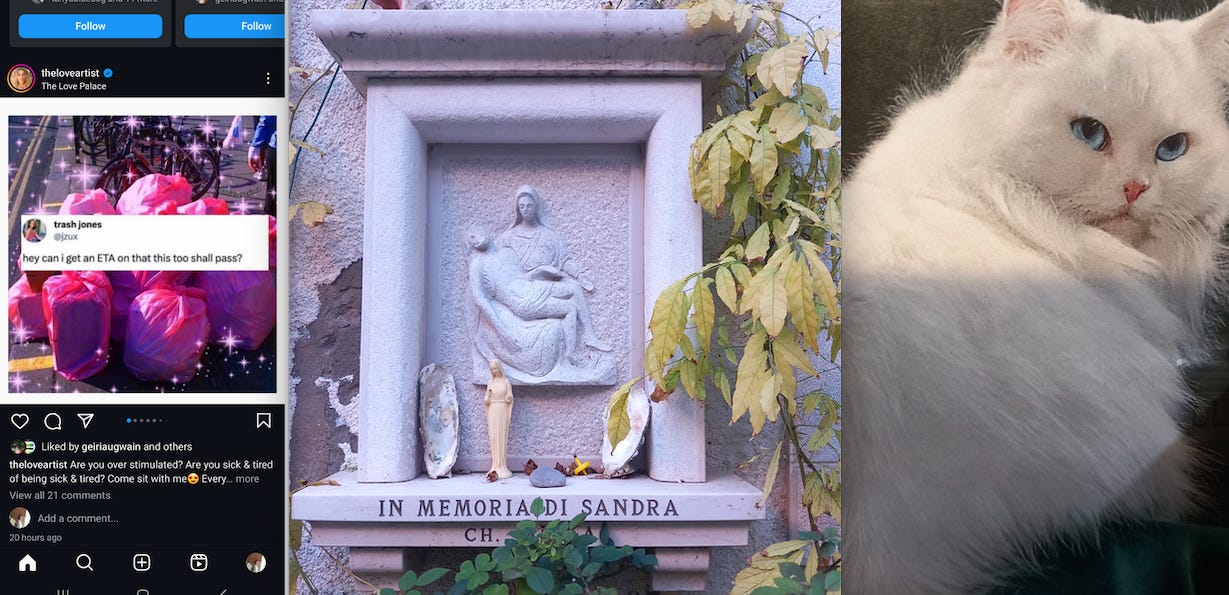
Can I get an eta on when this too, shall pass?
I have been thinking about the history, multiple definitions and uses of the term queer for two main reasons. Firstly, because I’m interested in thinking through how and if I can argue that the Lle Llais methodology is queer, and if I want to do this, and use queer theory to analyse and discuss the arts-based tools and processes used to develop and deliver the Lle Llais events. Secondly, I identify as queer. In terms of my own sexuality, I’m pan-sexual, and I don’t subscribe to the limitations of compulsory heterosexuality, cisgenderism and transphobia. Because of this, I identify as queer. I also identify with the values of queer theory; some of which I outline briefly in the below paragraphs.
Philosophically and politically, I’m on board with queering thought, bodies, ways of relating and being in the world. What this means in practice is problematising norms that inform heteronormativity (Jagose, 1996), and interrogating the diverse and complicated inequalities produced by the normative alignment of gender, sex and desire (Butler, 1990). Such inequalities around gender and sexuality are maintained by social norms and values, but also by social institutions such as schools, governments and statutory law.
For example, we can see an example of such inequalities at play in the UK, where this year, schools have been directed by the government to not teach gender identity in Relationship and Sex Education (RSE) classes (BBC, 2024). Further, existing research into the state of trans-inclusive education in secondary schools conclude that currently schools in the UK are designed around cisgender norms, as seen in gendered school uniform policies, changing facilities, and curricula that lack reference to trans experience (Johnson, 2024). In the context of secondary schools in the UK, cisgenderism is frequently the norm, leading to a hostile learning environment for non binary and trans children.
I want to tie in a quick definition of cisgenderism here, as I think it’s useful to hold in mind while thinking about the current gender inequalities being engineered in many UK schools. Lennon and Mistler define cisgenderism as: “cultural and systemic ideology that denies, denigrates, or pathologies self-identified gender identities that do not align with assigned gender at birth”(2014, p.63). Problematically, at present, there is lack of gender diversity reflected in curriculums and school environments in the UK, which in turn, contribute to schools as strongly binary institutions excluding those who do not adhere to cisnorms (McBride 2021).
In a queer experience of the world, non-normative expressions of gender, sexuality, desire and bodies matter. They are to be tended to, protected and advocated for, not repressed, shamed, dismissed and hidden under the veil of night or shitty and pathologizing government guidance and law. To occupy a queer body, a queer positionality, is to defy the insistence of ideas around what is respectable, permissible and even desirable under the conditions of eurocentric hetero-patriarchal capitalism. It is to mess things up, to refuse the conditions of binary and dualistic thought, to refuse to subscribe to the narratives and values of compulsory heterosexuality and heteronormativity. To be invested in doing and living queer theory, is to show commitment to trouble and expand the systems and processes by which we think, language and imagine and experience our genders and sexualities.
In the same breath, queer is inevitably a slippery and contested term. Which is where I return to the question asked at the start of this bit of writing; is it even possible or desirable to distil queer into a definition? At the moment, I think no - and yet, and yet, I’m keen to be in possession of some of the key ideas underpinning queer theory; a field of study that challenges existing traditional ideas about identity, sexuality, and gender – particularly that of heteronormativity, or the belief that heterosexuality is the natural, moral, or “normal” expression of sexuality. For queer theorists, heteronormativity permeates various aspects of society, is reinforced by institutions (think the Church, school, workplaces, and the legal realm amongst others), and is ultimately a way to yield power and control. So, in short - I don’t want to, nor do I think it’s possible to distil queerness into a succinct, fixed definition. At the same time I want to uphold enough clarity of definition of queerness for those of us living outside norms values and desires of heteronormativity to find a common cause, a common organising purpose under the hopes, dreams, tears, struggles and attempts to queering the world around us.
Trump’s Re-Election
I can’t not mention the exasperation, despair and concern arising from Trump being re-elected as American President. I have no more words that to write than the single word; No.
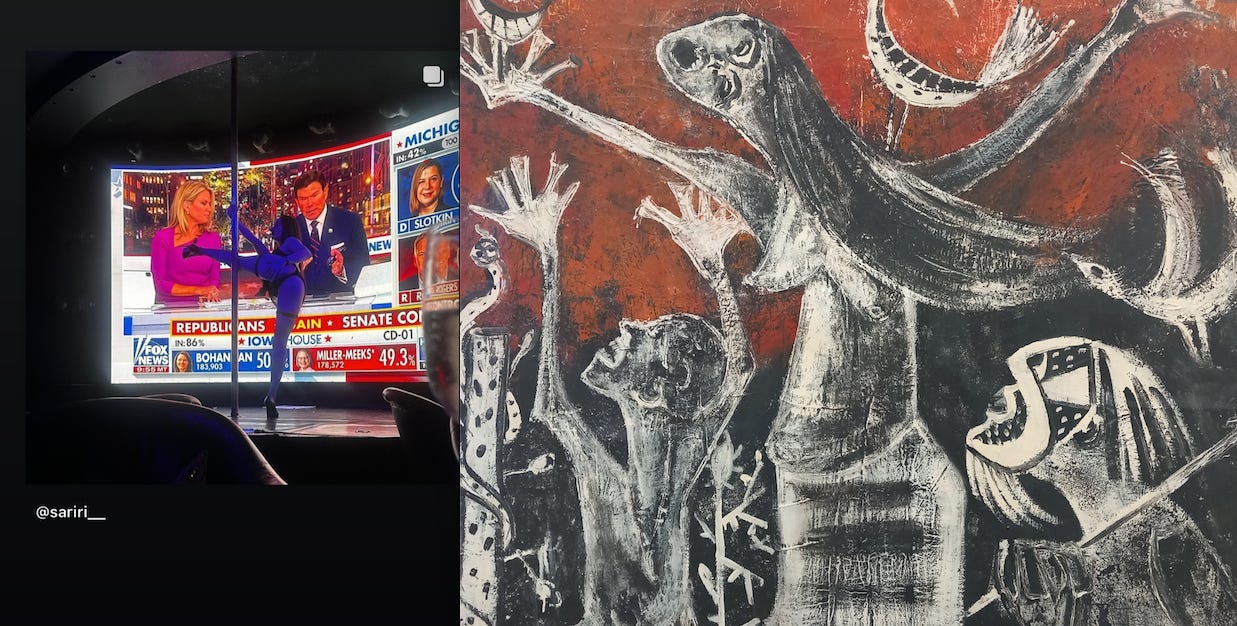
A solid instagram find, and an artwork from the Central Pavilion. Artist unknown