
Venice Week Three
Musings on feminist positionality, no fault evictions, ghosts and sex positivity

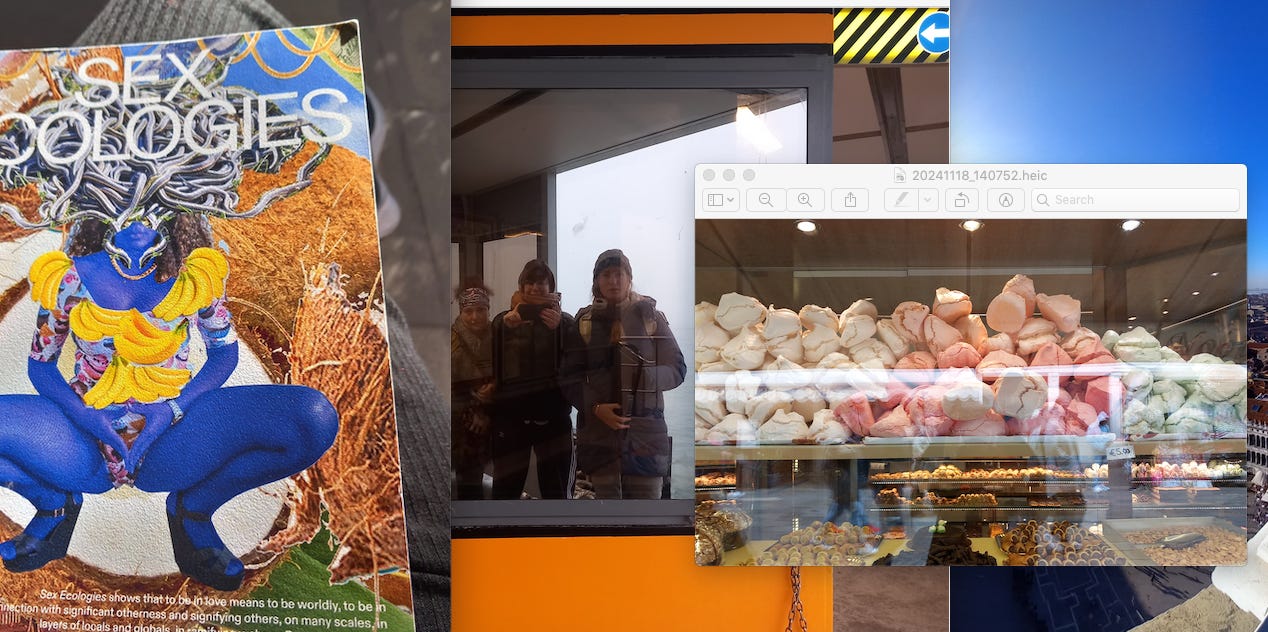
Sex Ecologies, Morning Vaporetto to the airport, a load of delicious meringues
Week three of the fellowship has been mostly quiet, which I have relished. I had my first week solo in the flat and the rhythms of everyday life here. I have felt back to my day to day norm of solo living, and having time-space to dictate and direct the ways in which I spend my days. This autonomy I realise, is vital to my sense of well-being. Cave time as dream time. Solo time as immersion in my creative practice. Solo time as less distraction (if I can keep my phone away from me).
The ongoing question for me is how to maintain connection with those I love and value, while being able to keep space for myself, solo, quiet, dreaming, making. And also, in amongst my cave time, exploring new and established creative collaborations.
Invigilating shifts have continued at the British Pavilion, and I have spent windows of time wandering around the city. Around work at the Pavilion, most of my time has been spent reading, writing and sleeping. I have also been communicating with mum about Sam's housing circumstances and the gross safeguarding failures playing out with the family support meetings, that are designed to protect Sam and the children from J, and yet this is not happening. In practice, I've been supporting mum, and proofreading her evidence base of where and how safeguarding failures are at play. Fun.
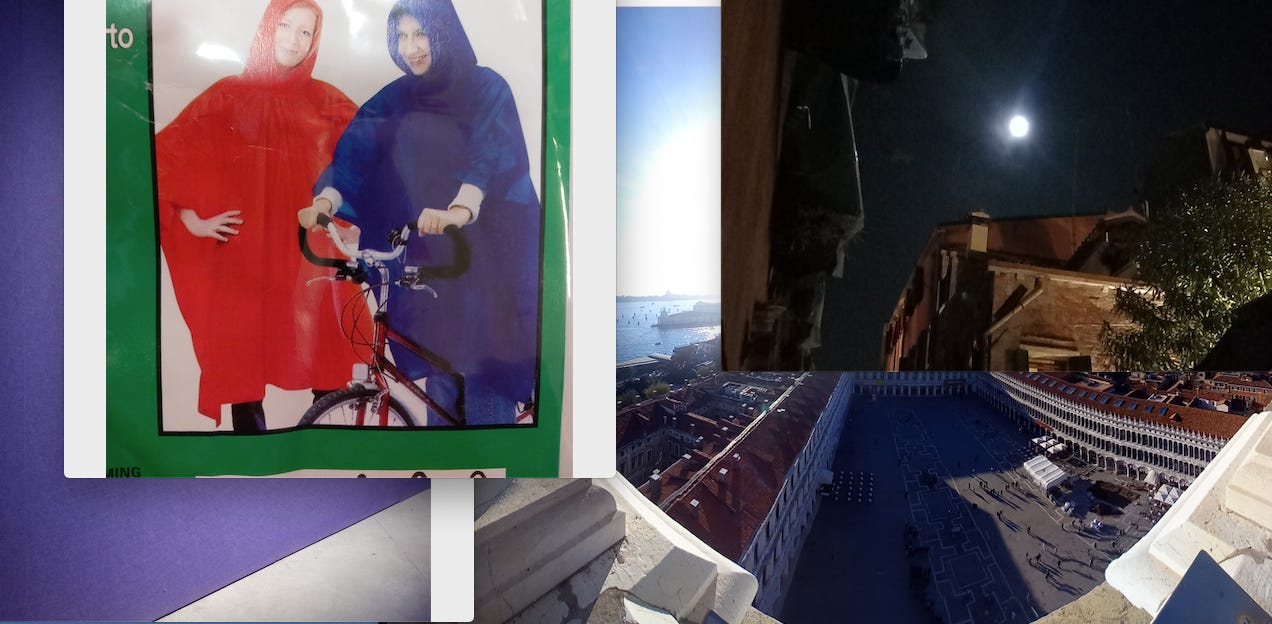
Owie and Charlotte arrived Thursday afternoon, and on Friday we walked 12 miles visiting a lot of key Venice sites. Ascending St Mark's bell tower on a clear skied day was a highlight, as was the Royal garden, behind St Mark's Square, opposite Basilica Santa Maria della Salute. I felt very at home in the regal garden, and edged closer to temporarily believing I was rich.
The Friday full moon rising over the North lagoon was enchanting as hell. The witches did gather. Apparently it's a beaver moon, with a lot of Taurean zodiac, which relates to grounding, sensuality, pleasure and tending to the luxuries and simple pleasures of life. I could do with more of that, so I'm aligning myself with pleasure, grounding, time in the dream space and tending to my interiority.
Vinny is arriving on Sunday, which is adding tension and anticipation to my days here. I'm really looking forward to seeing him. This feels like an a ridiculous understatement.
Feminist Positionality
Feminist positionality is central to my writing-thinking-feeling-making. It is a practice of Feminist thought and activism, that advocates for each person to specify and detail the specific social, cultural and economic positions from which they think, feel, relate, speak. I’ve been thinking about my writing, and my desire to share my writing with the internet. With unknown publics, as well as friends and colleagues. It seems important to me to detail a little about the position from which I speak.
“For feminist decolonial scholars, our positionality is the embodied pivot from which our knowledge-making materialises.”
Yvonne Te Ruki-Rangi-o-Tangaroa Underhill-Sem, Cook Island and Niuean New Zealand scholar (2020)
The purpose of positioning oneself, and doing that detailed work, is to be able to take ownership of one's specific context, position, privilege, struggle and cultural location. The practice of positioning oneself in relation to a whole range of social and cultural experiences and access to resources is of value because it is a method of detailing one's classed, gendered, racialized, sexual, health, body-mind, occupations, through which difference and privilege and oppression can be detailed. Not all Feminist experience or calls for change are the same, and difference is important to hold in mind and collective purpose. Without Feminist positionality, empty generalisations can become the norm, and often much more oppressed and disenfranchised people’s experience risk being erased under the knowledge claims, ideas and analyses of people with more forms of social, economic, and cultural capital and power.
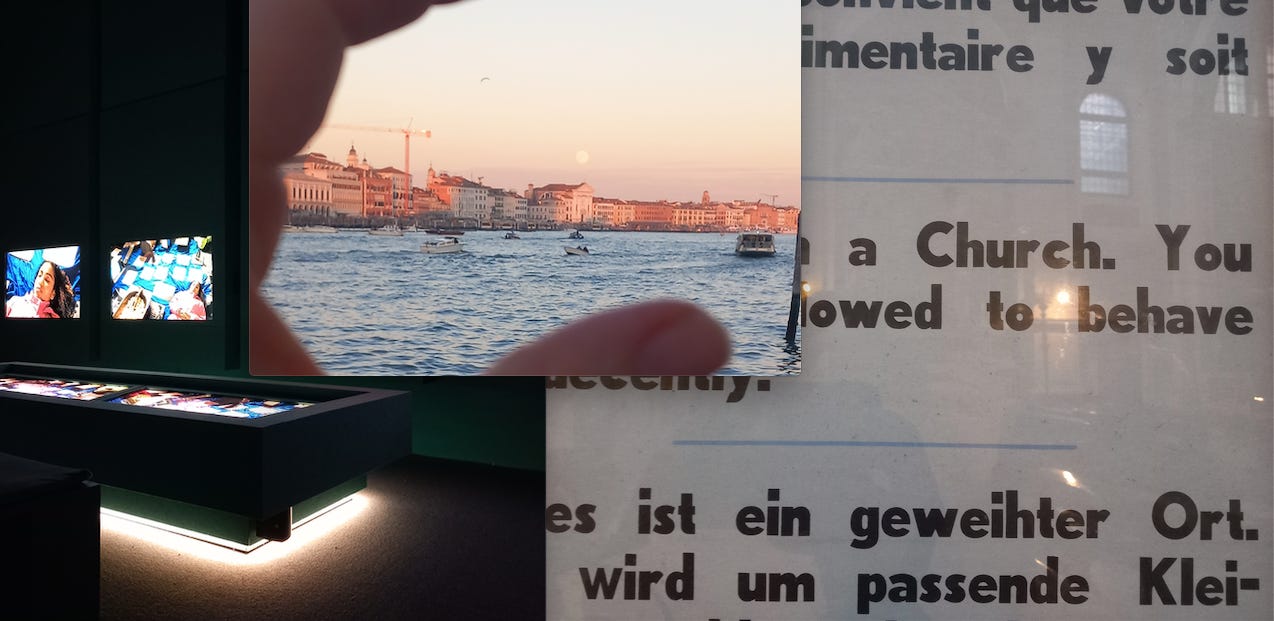
All night listening to the rain, fingers around the full moon, how to behave in church
So when I write, I am writing from my specific position. I will elaborate on my position more next week, but in summary, I write, feel and encounter the world as cis-woman from a single parent low income family. I am white, well-educated, and can bargain for well paid jobs (though often not secure) in the labour economy. I have housing security in the form of a mortgage of a terraced house. I live and run my house alone. I don’t have job security, but I feel confident I can get more work, and am planning on a longer term contract for my next role. I am relatively healthy, but grew up with inherited epilepsy, for which I was medicated and monitored until I was 30; this health issue was not without medical and social complications. I have a family under chronic duress for various reasons, in particular my twin brother. My father was absent growing up. I am born of a trans Atlantic tryst. There is profound and complex trauma in my family on both sides. There is so much more to say on my positionality, but I thought it important to detail the socio-economic, and embodied position from which I feel - think - write. The position from which I experience the world. I will be reflecting on my family story and context in a later post, as I think it is a thread I want to hold onto, trace, detail and make sense of for myself. I have a strong pull to focus in on my family stories as the topic for future work.
Nigeria Imaginary
The Nigerian Pavilion has been one of my favourite pavilions so far, along with the Nebula show.
The exhibition is titled Nigeria Imaginary and is curated by Aindrea Emelife. Located in the Dorsoduro, a vibrant arts district in Venice, I think the exhibition is in an old Venetian family house. As you walk in, a cavernous feeling overtakes, and there is the grandeur that slowly and subtly seeps out of so many of the larger buildings in Venice. It is clear this city is built on centuries material wealth.
The concept of Nigeria Imaginary comes from two points of departure. The exhibition sets out to explore the role of two moments in Nigeria’s history—moments of optimism—and moments of emergent instability, exploring a Nigeria yet to come into existence.
Nigeria Imaginary as a show, presents different viewpoints, ideas, memories, and nostalgias of the country, encompassing intergenerational and diasporic experiences and ideas. As well as looking backwards, the show includes speculative visions for a future Nigeria.
Artists included in the show work different mediums, including painting, photography, drawing, installation, sculpture, AR, sound, and film. The work that stayed with me after visiting was Ndidi Dike’s Blackhood; A Living Archive.
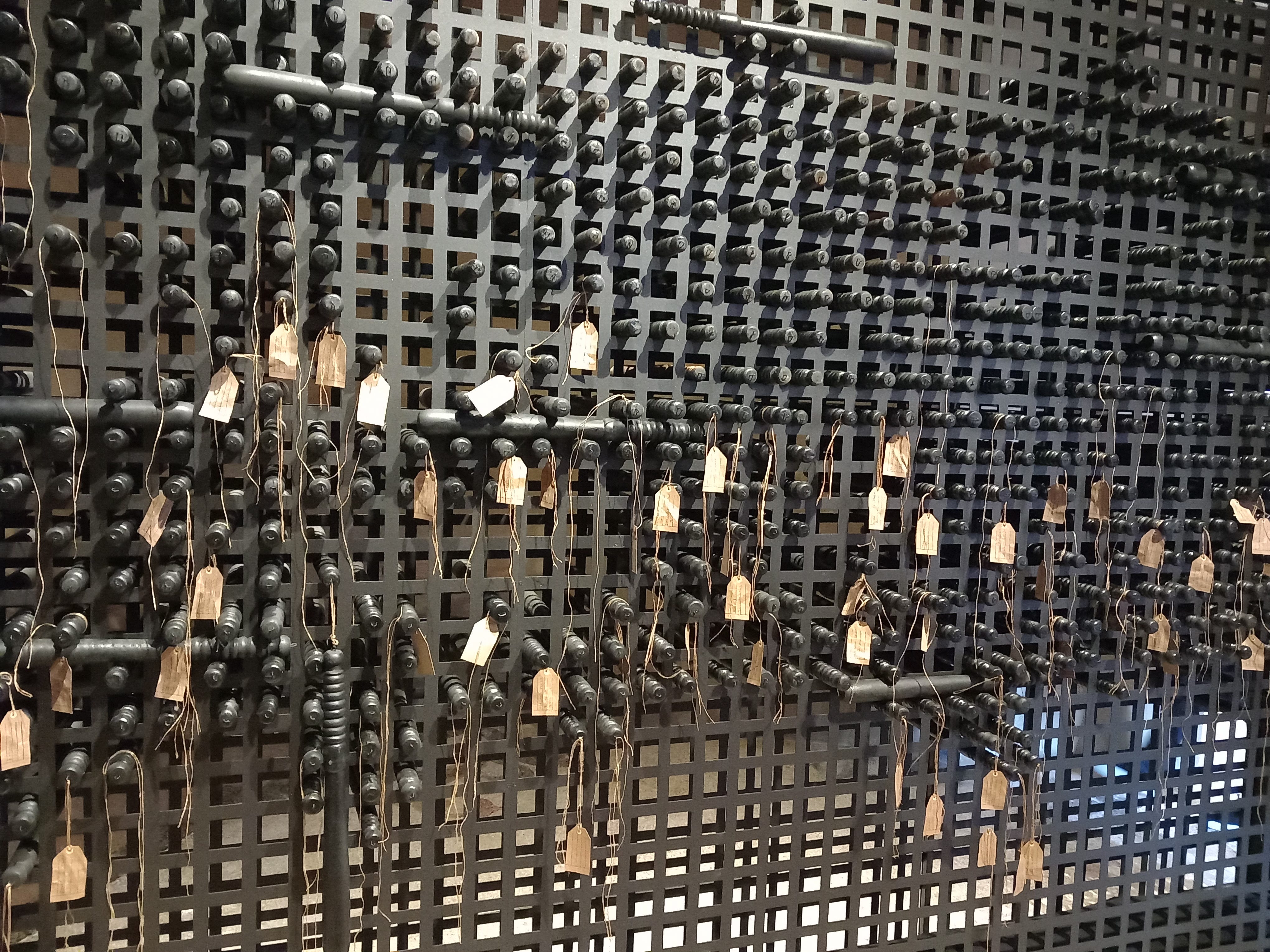
Ndidi Dike’s Blackhood; A Living Archive
This work was painful to experience. Yet it spoke candidly of the brutality used in Nigeria and beyond, historically and today.
The installation comprises a free standing structure consisting of seven hundred and thirty-six black wooden batons, each with a name attached. These batons signify the brutalisation of people in colonial and post-colonial Nigeria. Dike’s work is detailed on the Nigeria Imaginary website here:
"Blackhood: the Living Archive confronts viewers with the enduring legacy of policing violence. Dike prompts reflection on the exportation of American policing to Africa and its deadly consequences, urging consideration of escape from this history. The batons also memorialize those lost in the EndSARS movement, highlighting systemic injustices. Exhibited at Art 21 Lagos in 2021 in a different format, the installation demands attention to ongoing struggles against oppression.”
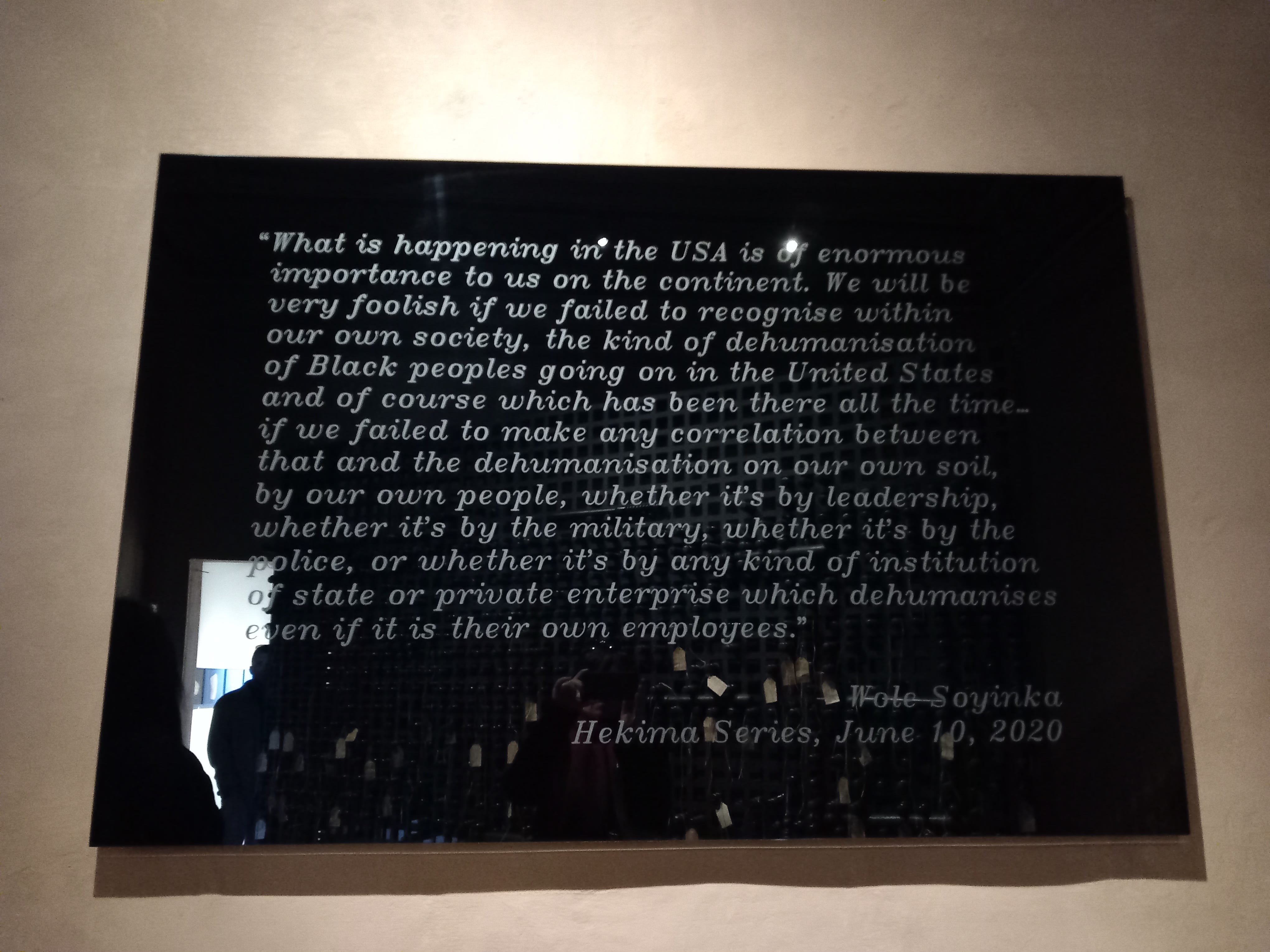
Ndidi Dike’s Blackhood; A Living Archive
Forced evictions, Section 21 & Homelessness
While out here, I've been staying in touch with mum, about the complex multi faceted crisis Sam finds himself in. I choose to write about this here, because I want to destigmatize family crisies rooted in abuse, local authority safeguarding failures, poverty and housing insecurity. Also, because I want to make visible the emotional pressure, concern and work that my mother is doing, and that at once seeps into and shapes the colour of my thinking-feeling while here on my fellowship. The personal is political, and I won’t and don’t want to erase this labour from view, or erase it from the documentation of my thought processes while out on this fellowship.
The brief summary of the current circumstance is that, on top of a whole host of other complex and severe crises, my brother and his two children, who he is the single parent of (the mother is not allowed unsupervised contact with the children), have been evicted under section 21 notice (no fault eviction). He’s already at the top of the local authority social housing list, and so far keeps being refused for properties he applies for, without any adequate explanation or reason. There is very limited affordable private rental housing stock where he lives. The prospect of homelessness in such circumstances is very real and extremely stressful for everyone in our small and under resourced family unit.
Some of you may already be knowledgeable about Section 21 eviction orders. Section 21 is a provision under the Housing Act 1988 that allows landlords to evict tenants without needing to provide a reason for eviction. It is a form of no fault eviction.
In my mind it’s clearly a deeply inequitable piece of legislation, because it means that tenants never have access to secure tenure. As if this needs pointing out, this is inequitable because one person gets to dictate the security and longevity of someone else's housing security. Further, the person dictating the housing security of the other, is often much more resourced and wealthy than the person they have legal rights to evict.
Section 21 can be used by landlords to evict tenants after a fixed tenancy ends - if there is a written contract and during a tenancy known as a periodic tenancy, which means a tenancy with no fixed end date. If landlords do choose to serve a Section 21 eviction notice, they must:
Give the tenant at least 2 months notice
The tenancy continues if the tenant chooses to stay past the date on the notice. The landlord must apply to court if they still want you to leave.
It is important to note that the tenant does not have to move out straight away, even if they have rent arrears.
The tenant can stay in the house, while the landlord applies for court proceedings. If the landlord takes the tenant to court, the tenant will then receive court papers. Court papers are issued because the landlord is taking action to make the tenant leave their home. This is known as starting a ‘possession claim’. The court will then decide whether the tenant needs to leave their home.
This process buys the tenant a bit more time to figure out what to do next, but it is risky because if the landlord wins, they can demand that the tenant pays the court costs. If legal aid is possible, and the tenant is eligible, the tenant might get protection from paying the landlord’s costs if they can’t afford them, though this is in no way guaranteed. This extra allocation of cost to the tenant facing eviction, on top of a Section 21, feels like a kick in the teeth, and deeply wrong.
Why I have to write about this, instead of the things I’m motivated by, is exasperating. But it is important to make this process and knowledge visible, because these experiences of precarity and unequal power relations are pervasive, and there is inadequate protection of renters; people who are often in low-paid, precarious forms of work, bearing the brunt of the cost of living crisis and forced to choose from over priced, precarious and poor quality housing. This is so widely spread, and impacts people’s day to day wellbeing on a profound basis. It is a political failure and a consequence of over 15 years of austerity and it makes me furious. Research shows us that sustained experience of poverty and precarity are directly linked to health problems and high mortality rates amongst young people. Insecure housing is a central source of stress, precarity and illness. Secure, safe and long term tenancies for renters should be a political priority and a basic right. Sadly, this is far from many people’s reality.
Erotophobia
While reading essays in Sex Ecologies, I keep bumping up against the term erotophobia.
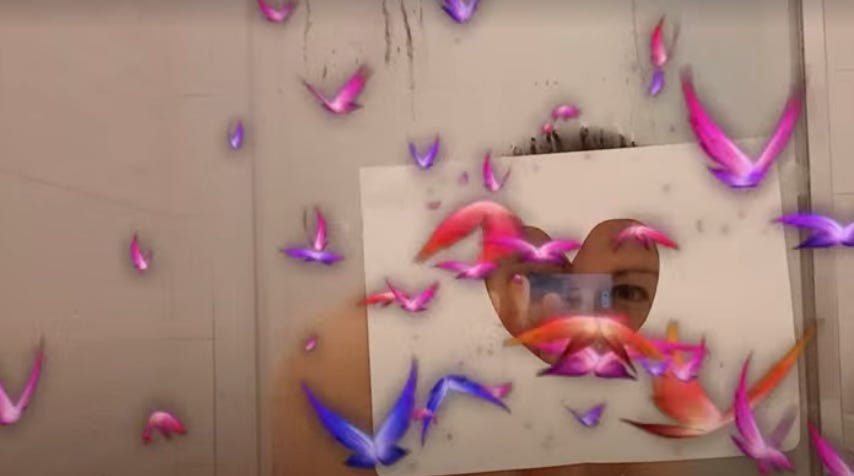
Love birds flying out of my face
Erotophobia describes a state of aversion, fear and dismissal of the erotic. As we know from Audre Lorde's uses of the erotic essay, the erotic is sexual, but it also describes a body's capacity for and openness to sensation, and a desire to tune into and act on individual desire as a form of resistance to racist, homophobic, patriarchal oppression.
“We have been raised to fear the yes within ourselves, our deepest cravings. For the demands of our released expectations lead us inevitably into actions which will help bring our lives into accordance with our needs, our knowledge, our desires. And the fear of our deepest cravings keeps them suspect, keeps us docile and loyal and obedient, and leads us to settle for or accept many facets of our oppression as women.”
― Audre Lorde, Uses of the Erotic: The Erotic as Power
Erotophobia is a term to describe a fear or aversion to sex or related matters. It was coined by researchers in the late 1970s and early 1980s to describe one end of a continuum of attitudes and beliefs about sexuality. “The word is derived from the name of eros, the Greek god of erotic love, and Phobos (φόβος), the god of fear. The model of the continuum is a basic polarized line, with erotophobia (fear of sex or negative attitudes about sex) at one end and erotophilia (positive feelings or attitudes about sex) at the other end.”
In this case, I’m not writing or thinking about individual experiences of erotophobia. Instead, I’m interested in erotophobia presented and acted out at a cultural and collective level. There is a paradox here, I know. We live in a world saturated by images of sex. Of sexualised bodies of many different genders. Promises of sex woven into visual marketing campaigns. Sexually empowered music videos, lyrics and fashion styles. Sex sells and sex is abundant in our day to day life. And yet, at the same time, candid conversations around sex, depictions of sex and sex acts and folk working as sex workers are frequently demonised, shamed and refused. It often seems to me, that the promise of sex is more socially acceptable than the demonstration and realisation of sex acts.
In my practice and research, I’m currently exploring themes of revolting, breaking, seductive, sexualised bodies. I’m interested in sex and sexual pleasure as a site of joy, pleasure, connection and consent based negotiation. I am interested in depictions, expressions and social responses to forms of sexual expression often looked down upon, stigmatised, deemed unrespectable.
Alongside an emerging focus on sex and sexuality in my work, I'm interested in queer sexualities, and how and with whom sex happens outside the heterosexual and heteronormative mainframe. The ways in which queer sex is culturally represented, permitted and experienced, and how these questions tie into a culture that seems to lurch from the promise of sex through all sorts of forms of visual culture, to the shaming of sex when it is embodied, enacted and done.
What further complicates erotophobia, is that certain sexualities are tolerated and permitted over others. Throughout history and currently, certain sexualities are legitimised by dominant social values and others are pathologized, shamed, repressed and punished. At the heart of this paradox lies a form of queer erotophobia.
As one way to make space to acknowledge, discuss and explore sex, sexualities and sexual expression, I try to incorporate queer sex positivity in my work, and am interested in centering this more in my practice. Perhaps I will discuss this term and my interest in it more next week.
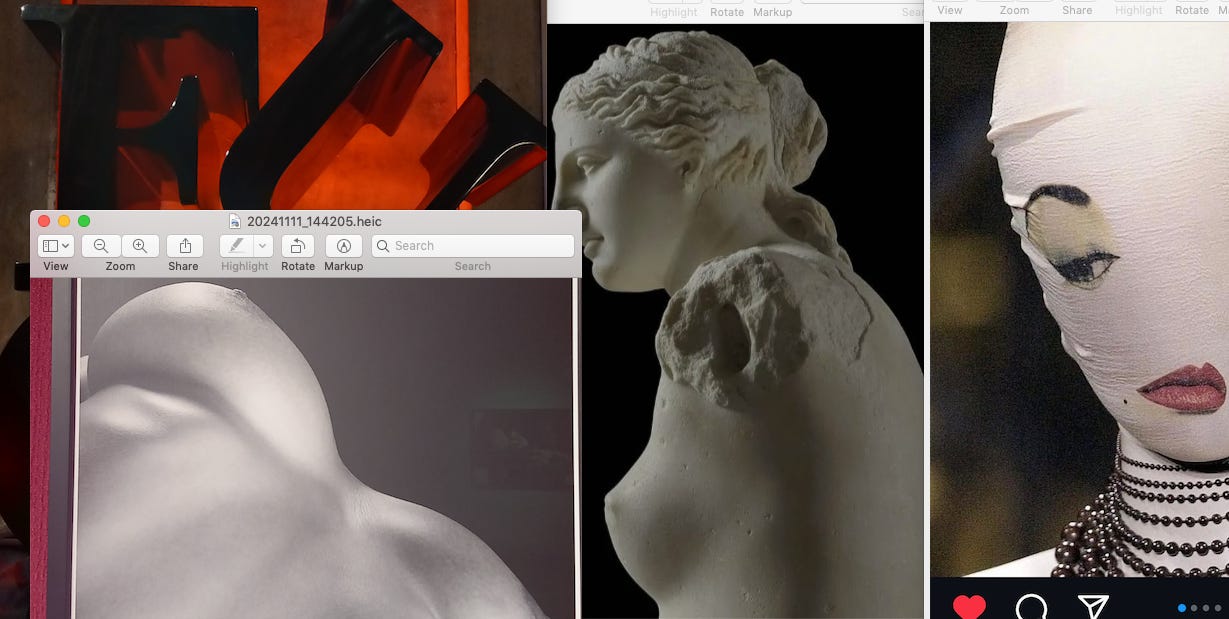
FUCK from Cameroon Pavilion, Robert Mapplethorpe, Venus, and Gaultier masks from 2004
Land of Dreams
I saw this work by accident, when I went to see the Breasts exhibition at Palazzo Franchetti. Land of Dreams was part of the exhibition Your Ghosts Are Mine.
Your Ghosts Are Mine comprises a range of film works made by film makers from the Middle East, Africa and Southeast Asia. The exhibition is co-financed by the Doha Film Institute and video works from the collections of Mathaf: Arab Museum of Modern Art and the future Art Mill Museum.
The films are mostly shown on two massive screens, with circular foam stools in the middle. The audience is essentially sandwiched between two enormous HD screens, with the chance to watch one screen successively, or flit and pivot between the two screens.
The work that called out to me the most was The Land of Dreams by Shirin Neshat and Shoja Azari. I think what I saw, was an excerpt from the longer film. The screen was really big, and I was drawn in by the image of a woman sat in a desert, a vast arid landscape, sorting through circles of print out photographs of people. As the wind blew, the papers were disrupted and disturbed. I loved the image of photographs of people blowing around a vast barren landscape. The camera zoomed out to show the scale of the paper assemblage. A tiny woman at the centre of her paper circle, dusty archive. What exactly this archive and process of collecting and sorting signified, was left ambiguous.
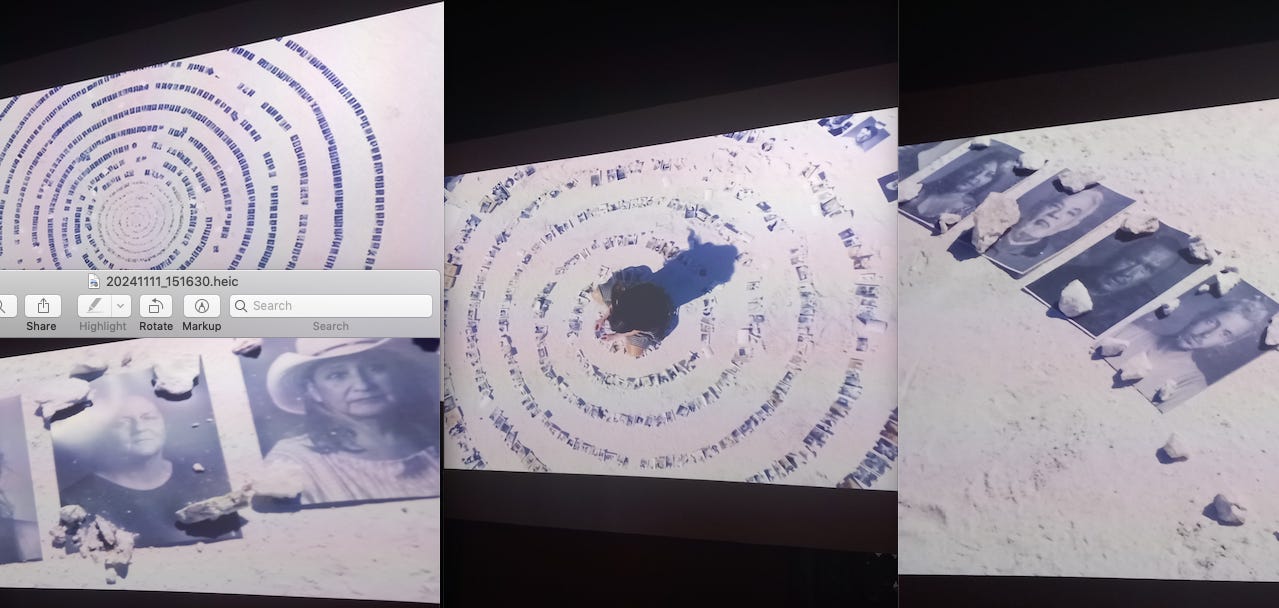
The Land of Dreams by Shirin Neshat and Shoja Azari
"Have you ever seen a nightingale fly in the dark night? It only flies at night if its nest has been destroyed or if it no longer knows how to find it. It is then that it becomes prey for the owl." Shirin Neshat & Shoja Azari
What I thought was powerful about the work was the depiction of the process of collating and sorting images. Analogue images printed onto flimsy and fragile bits of paper, subject to the strength of the elements. The visual language was austere, carefully staged, beautiful. Undertones of evidence gathering, sorting, watching, guarding, creating an archive. The image of a woman at the centre of her web, working systematically in a vast and empty landscape. It made me think of lost peoples. Migration. Displacement. Mothers looking for vanished children. Dysfunctional and inept governments; so much so that archives of people's lives are tended to and accounted for on flimsy bits of paper. Where do these bits of paper end up? Who is responsible for tending to the physical and digital archive of our lives?
The Ghosts Inside
Therapy was difficult this week. B asked if she could share some observations based on watching and listening to our sessions. I said yes, and she suggested what I already know. That being, I use over intellectualisation as a defence mechanism for tending to trauma and difficulties experienced in my formative years and family constellation. She's not wrong, and I already know this, but it was sore and upsetting to receive.
I know I have built this defence mechanism, and that it serves and rewards me well. But I am also at odds with this, because beyond smartness and intellect is a deep container of mess, filth, mayhem, contradiction, depth, sensitivity, sadness joy, a desire for deep connection and pleasure (oh god, and so much more). I would rather be a hot embodied sticky mess, entangled with others and leaking on the floor, than a big brain speaking through mouth and fingers alone. The question is - how do I make space to permit my sensing-feeling self to take up and over my intellectualising self. These parts of my psyche and personality are not at odds, and I am deeply proud and protective of my striver self, and yet, I would like her to be off duty for a while, so I can enter my dreamy, rich, time abundant Pre-Raphaelite phase.
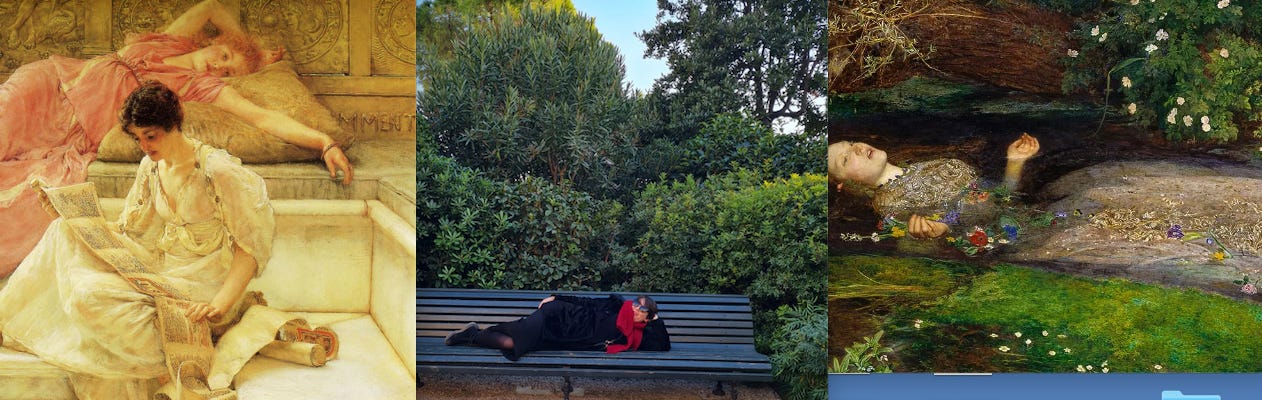
The Favourite Poet, Sir Lawrence Alma-Tadema, Pre Raph me, John Everett Millais, Ophelia,
Because I was exhausted, had been asleep for two hours prior to the session, and in bed, I somehow felt soft. Open. Tender. So we went into some deeper family stories, and it was painful. The tension of decades old struggle, mental illness and family loss surfaced, and my whole body leaked out anxiety, fear, grief. I think B was somewhat relieved to witness the tears and my emotional activation, as our sessions are often very abstract, descriptive, unemotional. I felt as if the sensations and emotions were unstoppable, as if I was too tired to try to repress and mask. Maybe bed is a good place for me to do my therapy. I’m sure these are the pictures I remember of psychoanalysis; people lying down, starting out the window, talking without restraint.
The thread we traced as my body contracted and loosened, contracted and loosened, was around this feeling I have, a just out of reach sense that I'm haunted by ghosts. But these ghosts are unknown. They aren't mine. They don't belong to my losses; the losses I have experienced. I mean, I have my own ghosts, but these ones aren't mine. They live on the sidelines of my consciousness. Just out of reach. I've often wondered where these feelings of deep sadness and worry / anxiety for my mother is rooted. It feels as if it’s really old. These feelings are mine but not mine. As if I've had a ghost transfusion when very young. Before a time I can remember. As if my body-mind is a host for other people's ghosts.
We followed this feeling and B asked me what images came to mind when she said the word family. The very first and immediate image was a butcher's meat display cabinet, with all the meat ruined, butchered, mashed up. That image dissolved as soon as it had appeared. Then I was in a vast empty black hanger. Not dissimilar to being inside a vast black veneer pot. The surface was very smooth. Earthen. Terracotta smooth. Rough to run your finger over, but earthen and of ground. Rooting. Messy. Not pristine. But dark. Very, very dark. There was a cavernous space. Like the visual metaphor used for 11's unconscious mind in Stranger Things. Except mine didn't have a serum like liquid floor. Mine was a chamber of black earth. Polished to immaculate smoothness. Very echoey. And very empty. An empty vessel filled with ghosts. When B asked if anyone else was there. I looked around. I could feel my mothers presence; it was warm. Soft. Comforting. A balm. She was encouraging me. She believed in me. I believed in her. It was my mother's voice coming from inside my cave. I wished for her to be next to me. To feel the firmness of her body. But the image nor sensation would not come. I remained, enveloped by my mother's voice. I remained alone, in a large empty hangar that was the image of my family. B asked me if I felt lonely. While I fully knew I was alone. I didn't feel lonely. I felt calm. Deeply serene. Quiet. It felt very familiar.
Raincoats, The View from Marco Bell Tower, and an imminent full moon