
Venice Week One
Reflections on arts-based research, single mothers, lack of sleep and the absence of horizons.

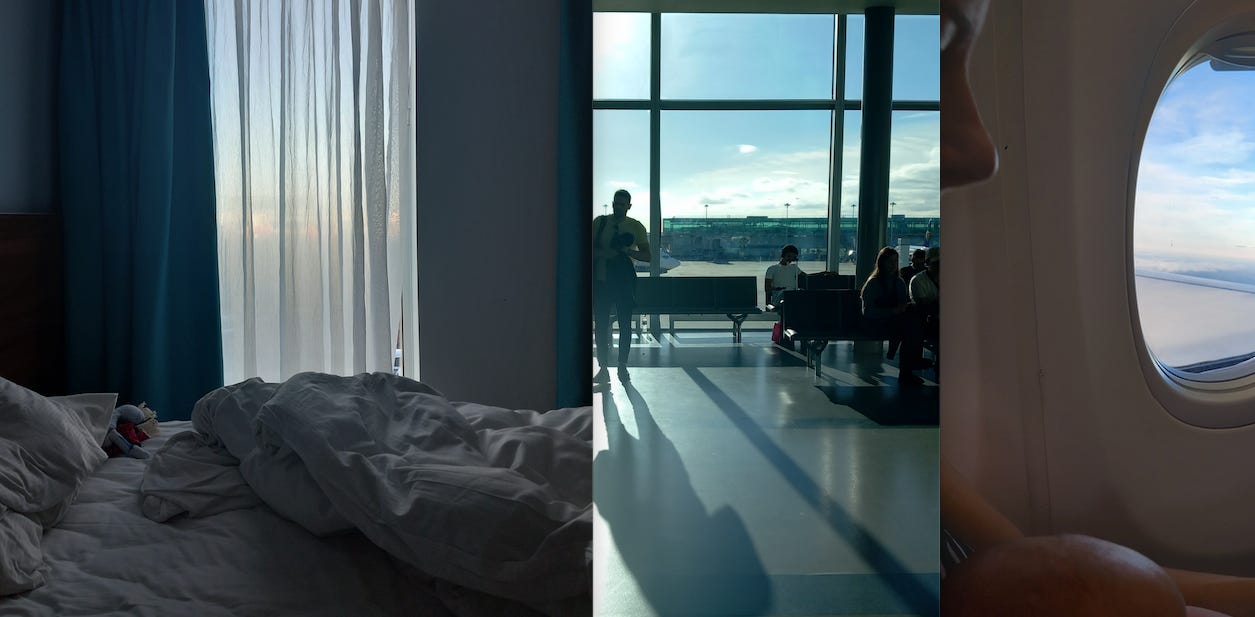
En route London to Venice with Holly and Arlo
This week was crazy. I hadn’t quite clocked the cumulative demands of working full time, meeting all the other British Council fellows, working at the British Pavilion about 21 hrs a week, and living with Holly and her 11 week old newborn, Arlo. Acclimatisation was long, and sleep was short. Venice seduced and repulsed at once. A city at once adored and stolen. On day three at work at the Pavilion, over 4000 bodies passed mine in close proximity. An art theme park the Giardini was. It was nice to have friends in the city at the same time. We went for a Samhain dinner, before poor Holly got the lurgy and vomited prolifically out of our balcony, and into the demure, quiet square beneath. By day 8, I had so far dodged the vomiting bug, and was starting to find some routine within which to weave together this paradoxical city, labyrinthine streets, the bonkers existential state that very small babies appear to have on me, time with Holly and a silly work load.
Arts Based Research
A lot of the reading I was doing this week was on the paradigm of arts based research. I was mostly reading Patricia Leavy’s Method meets art: Arts-based research practice (2015) and Tom Barone and Elliot Eisner’s Arts Based Research (2011). I’m reading this to contextualise the research I’m doing with Lle Llais engagement methods on the Public Map Platform Project, but as I read, I realise it is a valuable set of names for tools and ways of working I already utilise in my own creative praxis.
In this section of this week’s writing-musing, I tend to three key ideas that I think are interesting within research methods and approaches belonging to Arts Based Research (ABR) methodologies. I briefly discuss the different artistic mediums that can be used to do ABR, and outline how arts-based research methods differ from artistic production. I move on to discuss the philosophical and epistemological history and context of the ABR paradigm; specifically its departure from positivist epistemologies. I close with a brief discussion of the value of feminist standpoint epistemologies, and the ways in which ABR encourages research that explores the context of new knowledge, and not simply the justification and defence of new knowledge.
Arts-Based Research (ABR) is a relatively new, though established research paradigm. This qualitative methodology has emerged from the research into and practice of arts based therapies and ethnographic post-positivist research methodologies. At its most basic, ABR methods are a set of creative, hands-on, artistic research tools and processes used by researchers across all phases of the research cycle; research design, data collection and generation, analysis, interpretation and representation (Leavy, 2015, p.4).
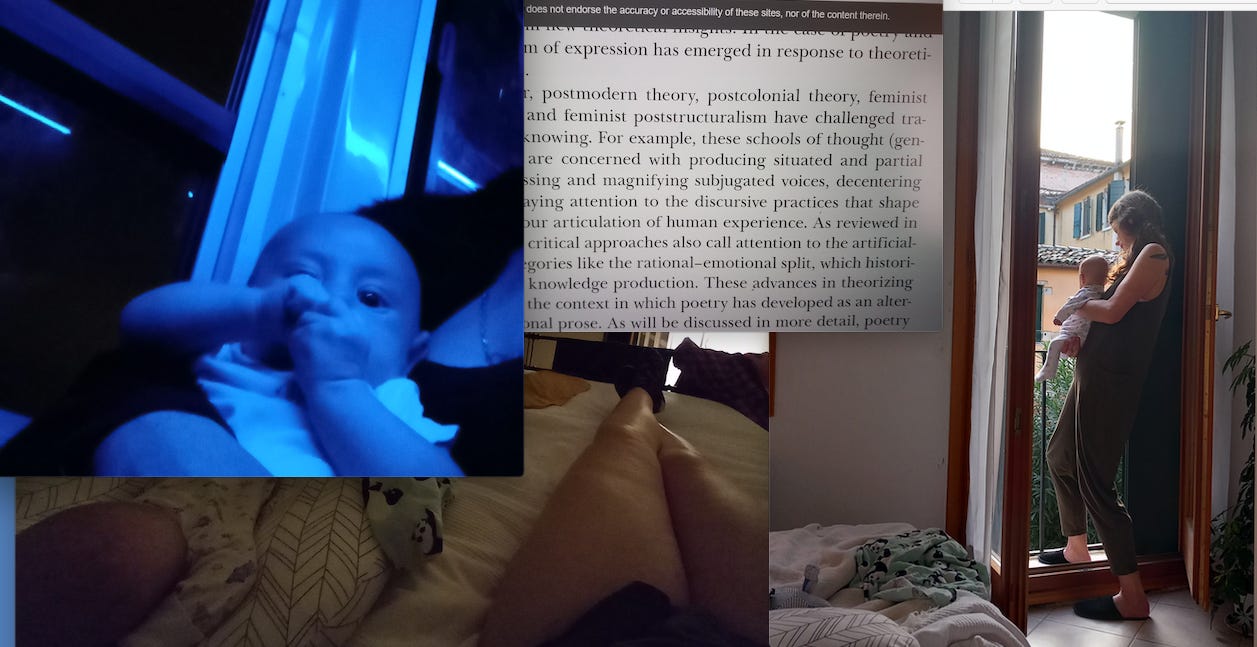
Reading, writing, baby and mumma shared time in our little flat
Arts based practices span a range of artistic media and modalities. As Leavy details “Arts-based practices draw on literary writing, music, dance, performance, visual art, film, and other mediums. Representational forms include but are not limited to short stories, novels, novellas, experimental writing forms, graphic novels, comics, poems, parables, collages, paintings, drawings, sculpture, 3-D art, quilts, needlework, performance scripts, theatrical performances, dances, films, songs, and musical scores” (Leavy, 2015, p.4).
The difference between artistic production, and arts-based research methods, are that ABR sets out to answer a research question, and that creative means of gathering and analysing data are deployed throughout the research cycle. However, the two are not mutually exclusive, because many contemporary and critical art practices place research based artistic enquiry at their core. Many artists working today are concerned with answering questions, deriving new knowledge, and challenging dominant epistemologies and values through material and aesthetic praxis.
All research methodologies are grounded in research philosophy, epistemology and ontology. New research methods do not come out of thin air. Instead, they often respond to and depart from previous ways of thinking-feeling and attempting to know the world. These wider research paradigms are important to consider, because a research paradigm constitutes a world view through which knowledge is filtered (Leavy, 2015, p.7). These filters are important lenses to pay attention to, because they inherently infuse and flavor the methodologies and research methods selected. So let’s briefly investigate the wider philosophical landscapes within which ABR sits.
ABR is a qualitative methodology, belonging to post-positivist epistemology. Qualitative research is generally characterised by an inductive approach towards building knowledge. This means that knowledge, in the form of principles or general theories, is derived from careful and systematic observations of the world around us. Post-positivist is a meta-theoretical stance which critiques the foundations of positivism. While positivists emphasise independence between the researcher and the researched person and claim researchers are able to develop knowledge objectively, post-positivist argue that theories, hypotheses, background knowledge and values of the researcher can influence what is observed, analysed and claimed as knowledge. For the post-positivist researcher, objectivity, and what Donna Haraway calls the view from nowhere is impossible. In this way, the key difference between positivism and post-positivist, is that post-positivist approaches account for researcher positionality and subjectivities within the research process, and set out to discuss the ways in which the subjectivities of the researcher give shape to the knowledge and insights claimed from the research process.
Many research methodologies already argue the importance of tending to, naming and reflecting on researcher positionality. Research methodologies such as feminist standpoint epistemologies, queer research methodologies, ethnography, auto-ethnography and ABR suggest researcher reflexivity, journaling and in depth self-reflection to account for how the specific knowledge and experience of the researcher shapes the knowledge and findings arising from the research process.
I’m going to take a moment to dig into the key ideas of feminist standpoint epistemology. This is because ABR draws on research approaches and tools developed within this research paradigm. I think the feminist standpoint research approach is really important because it advocates for context, analyses of power structures to be named, considered and acted upon within research and knowledge generation practices. Further, feminist standpoint epistemologies advocate for research that tends to and works with people experiencing different and often compounded forms of marginalisation and related socio-economic and political struggles.
The term marginalised groups can include the global majority, working class and precarious people, queer and LGBTQI groups, people of colour, single women, single mothers, the sick and the working sick amongst other groups. It is important to note that many of these experiences occur at once, resulting in compounded inequities and pressures; which raise the levels of hostility and oppression experienced by certain bodies over others. These stacked inequalities can be articulated through intersectional analyses (Crenshaw, 1989). Feminist standpoint epistemology is important because it demands the researcher accounts for their unique position and power in the design and delivery of the research and production of new knowledge, and because it acknowledges, describes and troubles problematic and harmful hierarchical social orders within and beyond the academy.
To conclude, ABR are a set of post-positivist qualitative research tools that set out to utilise artistic means of expression to gather new insights about the social world within which we live. Artistic process and practice can be used at each stage of the research cycle; research design, data collection and generation, analysis, interpretation and dissemination of findings. ABR has many unique features that I’ve not been able to discuss here, but one of them is a commitment to feminist standpoint epistemologies; the idea that research should both describe and analyze the causal effects of power structures on knowledge and everyday life, while also advocating a specific route for research; a route that begins from specific and lived standpoints emerging from shared political struggle, grounded in the complexity of intersectional, marginalised lived experience. In this way, ABR builds on praxis developed by queer and feminist scholars from the 1970s onwards. As Leavy details “ Arts-based practices are particularly useful for research projects that aim to describe, explore, discover, or unsettle. Furthermore, these research practices are generally attentive to processes. The capability of the arts to capture process mirrors the unfolding nature of social life, and thus there is a congruence between subject matter and method.” (Leavy, 2015, p.22)
Single Mothers
The first week in Venice was heavily punctuated by an insight into, and lived experience of the world of a new single mother. For the first week, I lived with my dear friend Holly and her 11-week old son Arlo. This was not an insignificant trio to cohabit in entirely new cultural and geographic climes and contexts for all of us. Holly lives with her mum, but the father, for complex reasons I won’t go into here, is not on the scene.
Observing Holly hold, feed and respond to Arlo’s every minute need was an exercise in vicarious adrenalin, deep curiosity, sleep deprivation and heartwarming love and humility. As any new parent will attest, this work is relentless, and while of course, in this context I was there to help at certain points, I was acutely aware of the labour of being a single parent to a helpless, extremely needy mollusc. New babies always seem more like molluscs to me. Soft, vulnerable, wriggly, with gooey, wet malleable gaping mouths, and attempting connection with the world through jolty moves and wet milky mouthed utterances. I was somehow, through this up close experience, directly connected to my own upbringing.
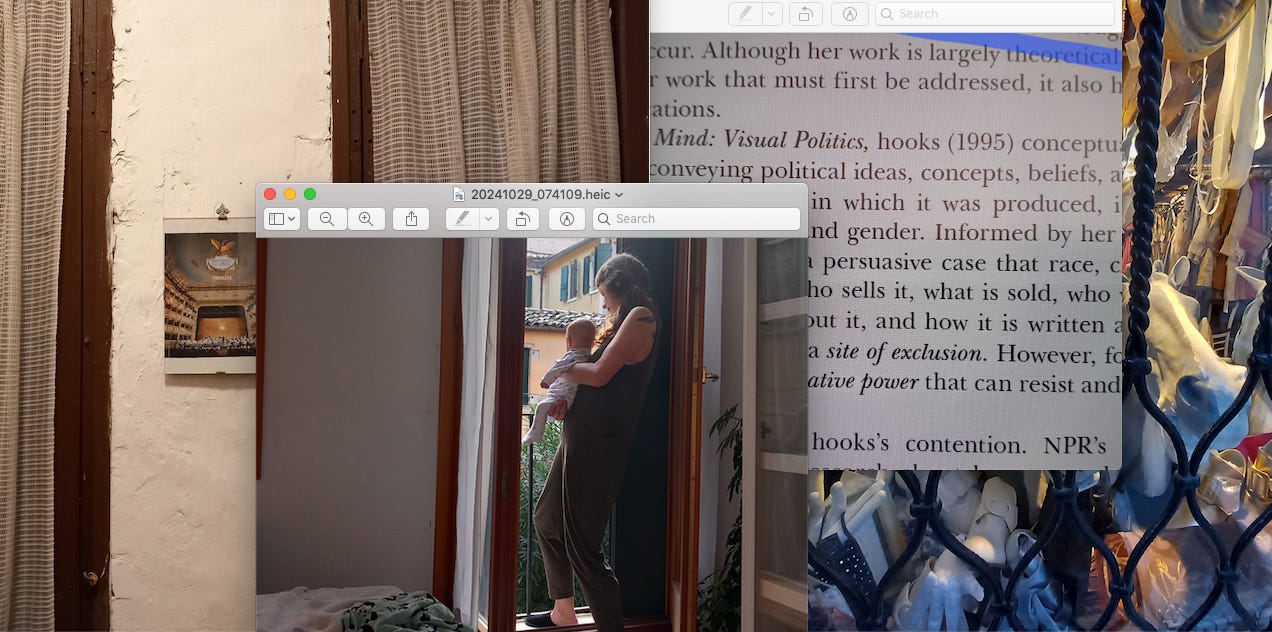
Holly and Arlo in amongst October - November Venice
Alongside this visceral, day to day reminder of the aptitude, ambivalence and struggle of single parents, and specifically single mothers, I have been thinking about my upbringing ALOT over the last few months. As I now have subsidised therapy, which means I can go weekly (£20 / hr because I have poverty in my family - a total game changer - so far, I could only afford therapy monthly), my therapist is asking me ALOT of questions about my family background and constellations. As she probes, and I tell, wince, tell, ignore, deny, draw, tell - I once again, realise that my situation is pretty complicated. In therapy speak, yes, it is true; I am a complex client. I can’t be arsed to go into the complexity and depth of my family context here, but a key thread that I’ve been tracing, is how being raised as a twin, by a competent yet under resourced single mother has shaped many parts of me; my skills, my sense of security, my sense of risk and scarcity, my lack of desire / strange desire for men, my anxiety fuelled worry for her, forged at a young age as a parentified child. Oh, single mothers of the world. You are surely saints. I wouldn’t want anyone else to have my back in a shitty situation. And yes, single mothers in my peer group and beyond, are my priority in terms of re-directing any surplus time or energy I might have.
For those of you reading, not from a single parent family, I invite you, for a moment, to really think about what it is like to raise a child or children alone. There is no one to witness your sleep deprivation. No one to tell you how well you’re doing while your nipples leak and hurt (if you are a female single parent), you can’t sleep, and in some cases, you don’t know if you can keep affording your rent. There is no one to help hold the door, while you drag in babies, a buggy, the shopping and yourself. There is no one to soothe you while you and the baby / babies cry. There is no one to witness and share your triumphs, the successes of your tears and struggles. So yes, in this moment, I toast the competence and heart of single parents, and specifically, the single mothers of this world.
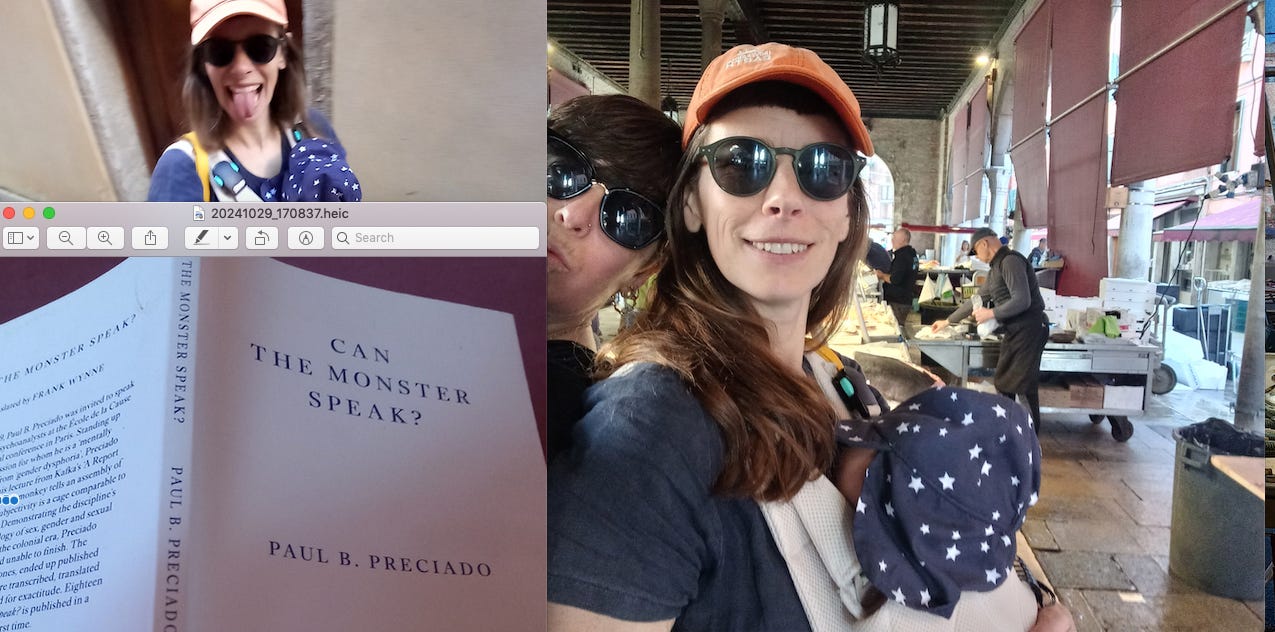
Reading, writing, and walking around town: notable trip to Rialto fish market
In observing Holly and Arlo at various points in their day to day imbrication - which included Holly becoming extremely sick for a few days, I wondered how the hell my own mother managed to look after, breast feed, feed herself, run the house, and just function with twins. To add to that, she was living in her dad’s house in Cornwall, well, come to think of it, so was I and my brother. When we were Eight months old, her dad, Douglas and his partner Kate, vanished at sea and were never found. So to add to the burden and complexity of single parenting two babies at once, there must have been significant grief, hoping and waiting that the vanished would return, and I know for a fact, she had to fend off the invasive pursuit of journalists keen for a tragic story.
There is such a rich seam of my family story to unpack here. And I have my family history and its intensity; a transatlantic chaos ream of a story, dogeared for a long time to make an art project about. It is not to go into here, but tracing the thread of my own origin story, being directly attached to being forged in a single mother household, continents away from my absent American father (who just absolutely HAS to be called Randy), has been one of the lines of involuntary thought and memory that has been following me around these labyrinth like streets this last week.
I consider this surfacing of single motherhood a kind of omen. The special and demanding time with Holly and and Arlo this first week in Venice, which was important and coveted for so many reasons, was also somehow a direct line, a body of connective tissue to an impulse latent in me; the desire to deep dive into my own relationship with and experience of growing up and continuing to live within a low-income single mother family. To be continued.
Limited Horizons
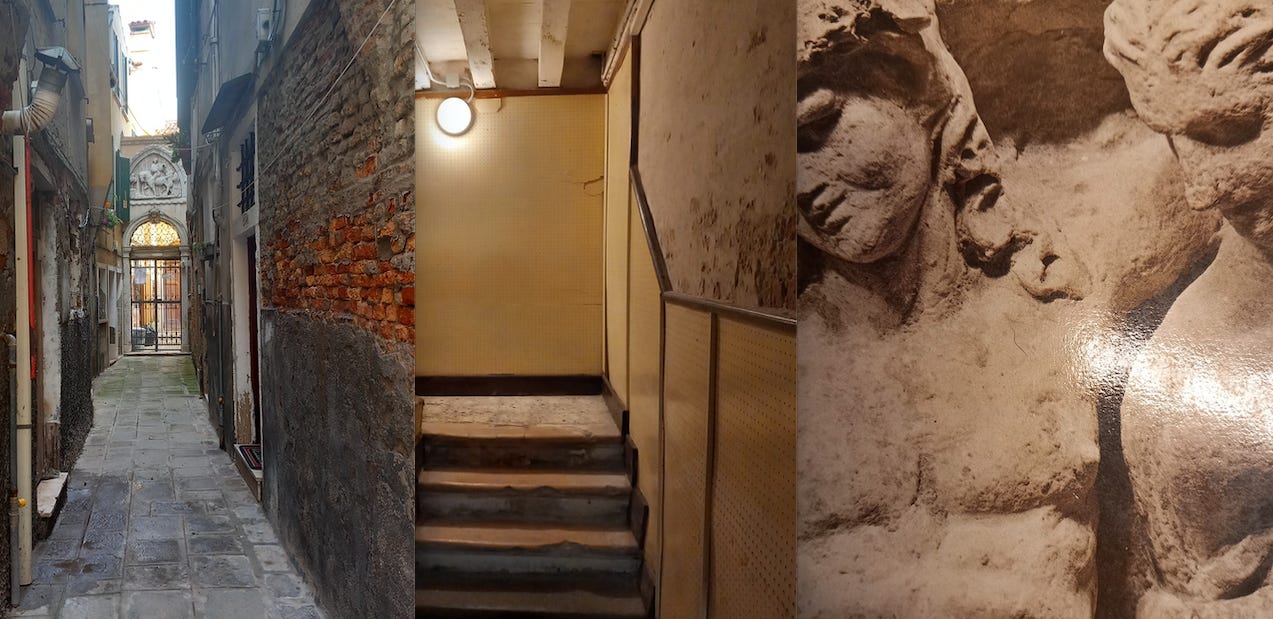
Venice calle’s, the entrance to the flat, a book cover I found in Aqua Alta bookshop
Calle de la Pieta. Turn right into Calle San Francesco, past Piazza Gritti, over Ponte San Francesco, down Salizada San Francesco, right onto Calle Morion. The tight labyrinth weave of streets that lead past tiny squares. To the left, Calle del Tedium, backing onto the large gas cylinders, Bonifica Gasometri, Venezia. Just behind, Ospedale, and Fondamente Nove leading onto Ponte dei Mendicanti. Tall, peeling multi-layered buildings, flanking endless bodies of water, with verdant cascades of plants trickling over window boxes. The only sky I can see is when I tilt my head back 90 degrees and drink in a slit of Blue or misty thick Grey. I’m sure having layers and layers of walls, paving stones and expanses of narrow bodies of water, is doing something to my psyche. I feel like I’m often on the hunt for something. Following a scent. Following some kind of primal drive. And the shadows and narrow passages that lead to darkness make me think of eros, masked lovers, horse-men, people who vanish slowly into the night, and then into the water. One calle leads to a pont, to steps that descend into the water. All senses are on fire, and yet there is a quietude to many of the routes I take in Castello. The vista’s I drink in, are found facing the North and South lagoons. Ospedale brings views as does my regular walk to Giardini on Riva degli Schiavoni. When my eyes fall on an expanded horizon, a stretch of unfolding and wide perspective, it’s like a nourishing exhalation. And yet, I’m captivated, drawn and seduced by the low lit alleyways, palimpsest walls, and close living quarters. I live on Calle de la Pieta. I have fallen in love with Campo San Francesco Della Vigna, and the cloistered garden and library. I really like the quiet neighbourhood, and the nearby shopping street, Salizada San Francesco is excellent. My flat is also one minute from the city squat, which hosts regular events, talks and orgnising meetings.
Less Sleep
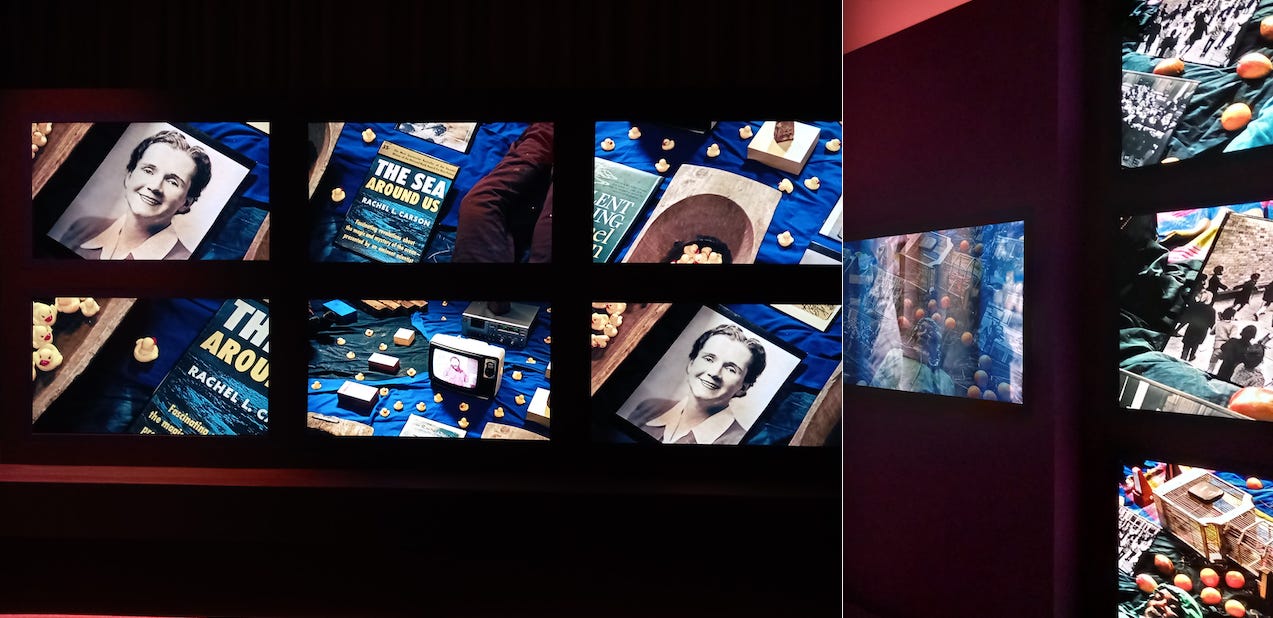
Stills from John Akomfrah’s Listening All Night to the Rain installation
Less sleep. Less sleep, and more less sleep. Due to reasons like a wonky bed, no sound privacy between my bedroom and Holly and Arlo’s bedroom, a new place, having a cold, family stress, and long working hours, in the first week I had less sleep, and more less sleep. I averaged three waking episodes a night, and about four hours a night for the first ten days. I was grumpy, uncomfortable and dissociated. However, by day four, I had given up hoping for better sleep, and instead decided to ride the strange perception that comes with sleep deprivation. Having made this decision, I spent much of the first week in Venice oscillating between feeling like I was suspended just above the surface of functional consciousness and perception, and a growling dissatisfied frustration. Thankfully, by the middle of week two, the time stamp from which I am writing this, I am heading towards more sleep, better sleep.
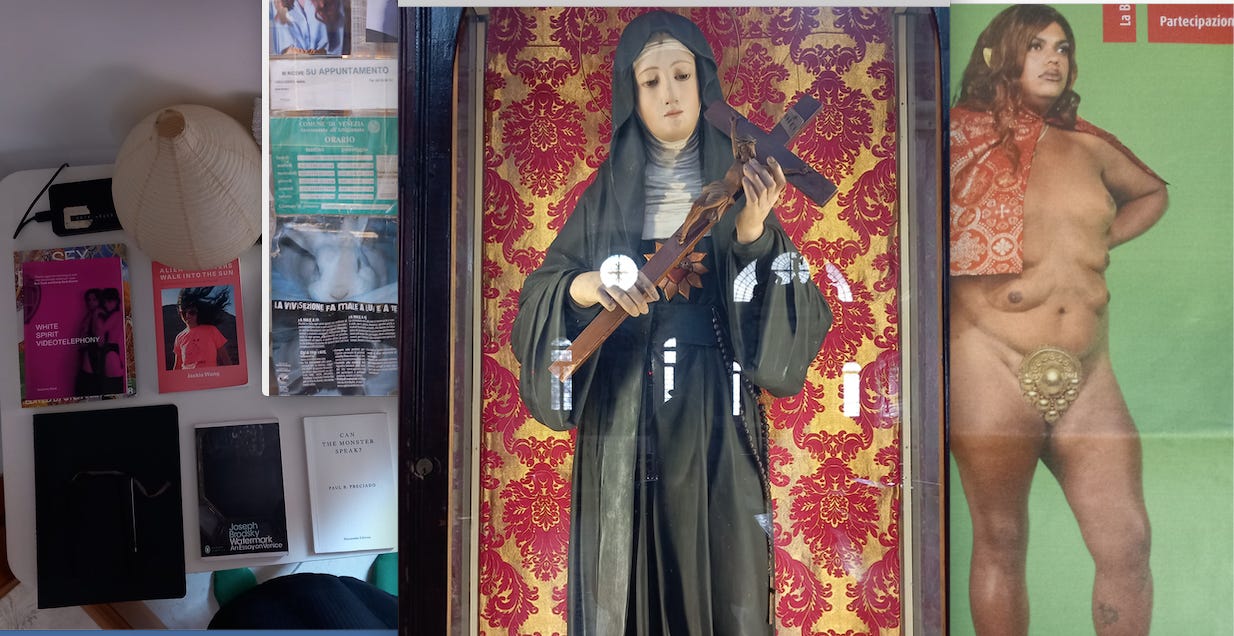
Stuff on my table, an installation from the nearby church and images from the Swiss Pavilion